
Introduction: Beyond Flesh and Bone
Every advanced yogi eventually reaches a point where mere muscle and flexibility stop being enough. The body feels strong, the asanas are mastered, yet something deeper calls from within — a current, a pulse, an intelligence that isn’t visible but can be felt. This is the subtle body, the energetic dimension of who we are. It’s the layer where nadis and chakras reside — a hidden architecture that silently shapes every breath, every pose, and every state of consciousness.
To truly evolve as a practitioner, it’s not enough to stretch your hamstrings or balance on your forearms. Mastery emerges when your physical practice becomes a dialogue with your energetic anatomy, when you begin to move not just muscles, but prana — the life force itself. Understanding the chakras and nadis isn’t mystical decoration on top of yoga; it’s the very blueprint that makes advanced practice transformative rather than merely physical.
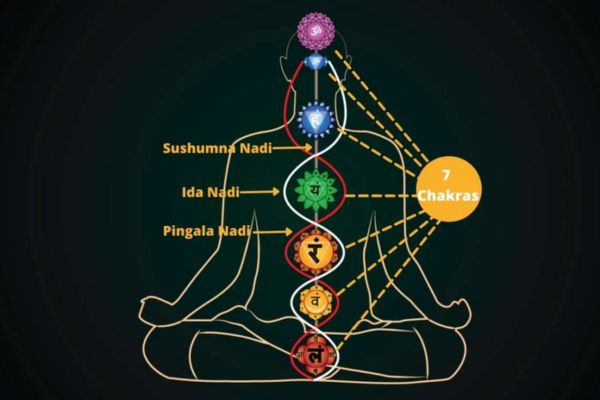
The Subtle Body: The Hidden Layer of Human Potential
Classical yoga texts such as the Upanishads, Hatha Yoga Pradipika, and Shiva Samhita describe the human being as composed of multiple layers, or koshas — from the dense physical body to the innermost core of consciousness. The pranamaya kosha, or energetic sheath, sits just beyond the physical, bridging body and mind. This is the subtle body.
Think of it as the electric circuitry behind the visible structure of your home. The walls (muscles, bones, tissues) are what you see, but the electricity (prana) is what makes the whole system alive and functional. If the wiring is blocked or misdirected, the lights flicker — just as our energy, emotions, and focus do when the nadis are obstructed.
Nadis: The Pathways of Life Force
The Sanskrit word nadi means “flow” or “channel.” Yogic tradition describes 72,000 nadis crisscrossing the subtle body — conduits for prana, the vital energy that sustains all bodily and mental functions. While many remain unnamed, three are considered the master channels:
1. Ida Nadi – The Lunar Current
- Originates on the left side of the base of the spine and spirals upward, ending in the left nostril.
- Associated with the parasympathetic nervous system, cooling, introspection, intuition, and the feminine principle (chandra).
- Activates the right brain — creativity, emotion, and inner awareness.
2. Pingala Nadi – The Solar Current
- Originates on the right side of the base of the spine and ends in the right nostril.
- Linked to the sympathetic nervous system, heat, activity, logic, and the masculine principle (surya).
- Stimulates the left brain — analysis, structure, and external action.
3. Sushumna Nadi – The Central Axis
- Runs through the spinal column, connecting the base of the spine (muladhara) to the crown of the head (sahasrara).
- It is dormant in most people, but when awakened, prana ascends through it, leading to expanded states of consciousness and the possibility of samadhi.
Advanced yoga is, in many ways, the art of clearing and balancing ida and pingala so that prana can enter sushumna. When that happens, asana transcends exercise — it becomes a vehicle for awakening.
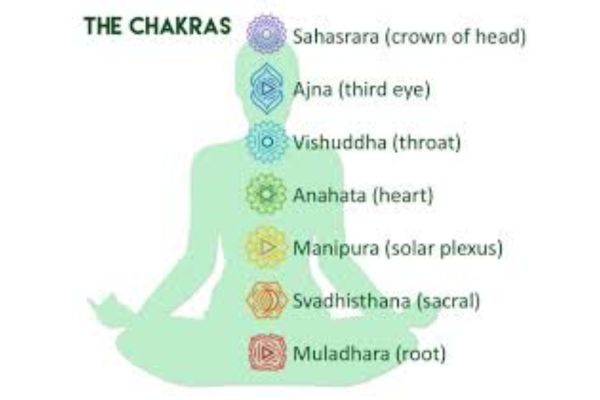
Chakras: The Energetic Control Centers
While nadis are the pathways, chakras (“wheels”) are the powerful junction points where energy gathers, transforms, and redistributes. Imagine the chakras as transformers on a power grid, stepping energy up or down to match the needs of the body, mind, and spirit.
There are seven primary chakras aligned along the sushumna nadi. Each one is more than a concept — it is a multidimensional center influencing physical organs, hormonal systems, emotional states, and consciousness itself.
| Chakra | Location | Element | Function |
|---|---|---|---|
| Muladhara | Base of spine | Earth | Grounding, survival, stability |
| Svadhisthana | Sacral plexus | Water | Creativity, sensuality, flow |
| Manipura | Solar plexus | Fire | Power, will, transformation |
| Anahata | Heart center | Air | Love, compassion, balance |
| Vishuddha | Throat | Ether | Expression, truth, resonance |
| Ajna | Between eyebrows | Light | Intuition, clarity, vision |
| Sahasrara | Crown | Consciousness | Unity, transcendence, awakening |
Far from being symbolic, these centers reflect real psychophysiological intersections. For example, Manipura’s location near the solar plexus links directly to the enteric nervous system and adrenal response, while Vishuddha’s role in communication aligns with the vagus nerve and vocal apparatus. Yogic science, in its poetic language, was mapping what modern science is only now beginning to decode.
Where Classical Wisdom Meets Modern Science
It’s tempting to think of chakras and nadis as purely mystical, but contemporary research is drawing fascinating parallels:
- Neural and fascial pathways: Nadis likely correspond to myofascial meridians, nerve plexuses, and subtle interstitial pathways that conduct bioelectric signals.
- Endocrine system: Each chakra’s location aligns with a major gland — from adrenal (Muladhara) to pineal (Sahasrara). Chakra activation mirrors changes in hormonal cascades.
- Breath and autonomic balance: Ida and pingala reflect the parasympathetic and sympathetic branches. Practices like alternate nostril breathing directly modulate these systems.
- Brain wave states: As prana rises through sushumna, practitioners shift from beta to alpha and theta states, correlating with expanded awareness and meditative absorption.
This isn’t coincidence — it’s evidence that yogic seers mapped a subtle reality that science is only now catching up with. Understanding this bridge gives practitioners a new confidence: working with chakras and nadis is not esoteric fantasy; it’s applied inner science.
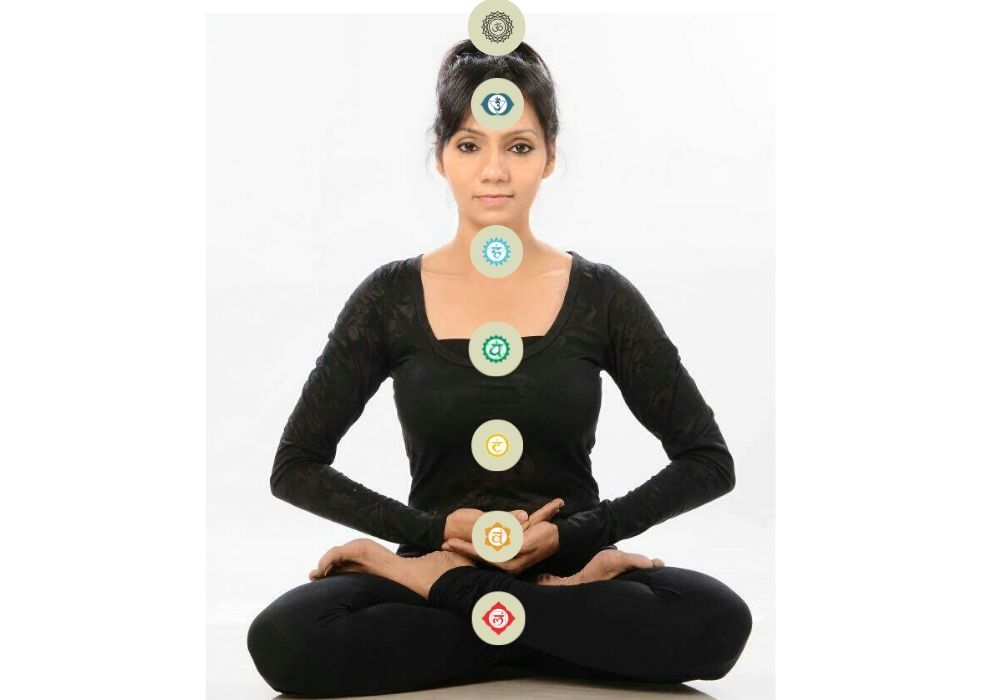
Awakening the Energetic Network: From Asana to Prana
In early practice, asanas strengthen muscles and improve mobility. But in advanced stages, the asana becomes a vessel for directing energy. The intention is no longer “stretch here” or “engage there,” but “guide prana along this channel” or “stabilize energy in this chakra.”
Here’s how advanced practice shifts:
- In backbends, the goal isn’t just spinal extension — it’s opening anahata and unblocking prana flow through the thoracic region.
- In inversions, it’s not just core strength — it’s reversing pranic flow, awakening ajna, and drawing awareness inward.
- In twists, we’re not merely wringing the spine — we’re balancing ida and pingala, clearing pathways for sushumna activation.
Even breath becomes less about oxygen and more about pranic modulation. Every inhalation is an invitation for prana vayu to ascend, every exhalation a grounding of apana vayu — and their union at the navel stokes the inner fire (samana vayu), igniting deeper transformation.
Practices That Refine the Subtle Body
To truly awaken chakras and nadis, advanced practice integrates more than just physical postures. It requires cultivating sensitivity, precision, and inner stillness. Key methods include:
1. Pranayama: Sculpting the Flow of Prana
Techniques like nadi shodhana (alternate nostril breathing) balance ida and pingala, preparing the ground for sushumna activation. Kumbhaka (breath retention) builds internal pressure, pushing prana into subtler channels.
2. Bandhas: The Energetic Locks
- Mula bandha draws energy upward from the root.
- Uddiyana bandha lifts it through the abdomen.
- Jalandhara bandha seals it in the upper channels.
Together, they create a pranic vacuum, guiding life force into sushumna like water through a narrow channel.
3. Mudras and Mantra: Refining Sensitivity
Gestures like maha mudra and seed sounds (bija mantras) vibrate specific chakras, stimulating dormant centers and tuning them like musical strings.
4. Meditation and Visualization
Stillness refines perception. Visualization of light rising through sushumna or petals opening at each chakra awakens the practitioner’s inner experience and builds subtle awareness.
A Shift in Perspective: Practicing With Energy, Not Just Body
Perhaps the most profound shift for advanced practitioners is how they perceive their practice. No longer is yoga just a set of poses to master — it becomes a living dialogue with prana.
- Instead of doing a pose, you listen to where energy is stagnant or overactive.
- Instead of chasing deeper shapes, you chase deeper sensitivity.
- Instead of asking, “How does this stretch my body?” you ask, “How does this move my consciousness?”
This is why true mastery in yoga cannot be measured by physical skill alone. Two practitioners may both balance in a handstand — but only one may feel the subtle ascent of prana along sushumna, the awakening of ajna, the stillness beyond thought. That’s the difference between performing yoga and being transformed by yoga.

Living Through the Chakras: Transformation Beyond the Mat
As practice refines the flow of prana, something extraordinary happens: your entire psychology reorganizes. Each chakra represents not just an energy center but a stage of consciousness. Progressively awakening them is like climbing an inner mountain:
- Grounding fear and survival (muladhara)
- Channeling creativity without attachment (svadhisthana)
- Transforming will into purpose (manipura)
- Expanding from self-centeredness to compassion (anahata)
- Speaking truth without distortion (vishuddha)
- Seeing reality clearly (ajna)
- Dissolving the sense of “I” into pure awareness (sahasrara)
This is why working with chakras and nadis changes more than your practice — it changes who you are. Your reactions soften, your perception sharpens, your identity shifts from the limited to the infinite.
Conclusion: The Next Frontier Is Within
For the advanced practitioner, the greatest frontier is no longer on the mat — it is within the subtle body. Strength and flexibility are merely the doorway; the real journey begins when you start to sense, shape, and surrender to the invisible rivers of prana that flow within you.
Chakras and nadis are not abstract metaphors. They are the silent blueprint guiding your transformation — from body to energy, from effort to awareness, from self to Self. When you learn to practice not just with your body but with your pranamaya kosha, yoga ceases to be something you do. It becomes something you are.
The mat then is no longer a stage for postures, but an altar for awakening. And each breath, each asana, each moment of stillness is a step deeper into the vast and luminous landscape of the subtle body — the true home of yoga.