
When most people set out to learn yoga, they imagine building flexibility, gaining strength, or perfecting difficult poses they see on Instagram. But true mastery of yoga isn’t about force or flexibility — it’s about tensegrity: a harmony of tension and structure that gives the body effortless strength, poise, and grace.
If you’ve ever wondered why some practitioners seem to “float” into headstands or move like liquid through arm balances — it’s not because they have superhuman muscles. It’s because they’ve learned how to use balanced tension and elastic integrity across the entire body.
In this post, we’ll explore this next-level approach to learning yoga — one that goes beyond muscle, into the subtle yet powerful realm of tensegrity and structural balance.
What Does It Really Mean to “Learn Yoga”?
To learn yoga is not just to memorize postures or follow an instructor’s cues. It’s a journey toward understanding how your body organizes itself under gravity. Every asana you practice — whether it’s Tadasana (Mountain Pose) or Eka Pada Galavasana (Flying Crow) — is a dialogue between stability and mobility, between structure and softness.
When beginners start yoga, the focus is often on external alignment:
- Are my hips square?
- Is my back straight?
- Can I hold this pose for 30 seconds?
But as you advance, the real questions shift inward:
- How is tension distributed through my fascia and connective tissue?
- Am I pushing or yielding to gravity?
- Where can I find effortlessness within effort?
This is where the science of tensegrity begins to reveal itself.
Understanding Tensegrity: The Hidden Architecture of the Human Body
“Tensegrity” is a term borrowed from architecture, originally coined by Buckminster Fuller. It combines the words tensional and integrity — describing structures that stabilize themselves not through rigid frames, but through a network of continuous tension and discontinuous compression.
Imagine a geodesic dome — its shape is held together not by solid walls but by the even pull of cables and struts. In the human body, bones act like the compression rods, while muscles, tendons, and fascia act like the tension network.
Your body doesn’t hold itself up because your bones “stack” perfectly — it holds itself up because of balanced tension throughout the entire system.
In yoga, this means every asana is not a static position but a living system of micro-adjustments — where tension is intelligently distributed to create stability without strain.
When you learn yoga with this awareness, your practice evolves from mechanical repetition to structural intelligence.

Why Muscular Strength Alone Limits Your Growth
Most practitioners hit a plateau in yoga because they rely too heavily on muscular strength. They push harder, hold longer, or stretch deeper — thinking progress means doing “more.”
But the problem with this approach is that muscles fatigue, joints compress, and flexibility without tension leads to instability.
When you begin to learn yoga through tensegrity:
- You stop “locking” joints and start “floating” bones in space.
- You stop isolating muscles and start integrating the whole body.
- You stop over-efforting and start using intelligent engagement.
For example, in a pose like Urdhva Dhanurasana (Wheel Pose) — the novice tries to “lift” the body upward using the arms and legs. The advanced yogi distributes tension through the fascia chain — from the soles of the feet to the crown of the head — creating a spring-like expansion that naturally lifts the chest.
It’s not brute force. It’s biotensegrity in action.
The Fascial Connection: The Missing Link in Yoga Practice
Modern anatomy often teaches us to see muscles in isolation — quadriceps, hamstrings, deltoids — but in reality, these muscles are bound together in one continuous web of fascia.
Fascia is the connective tissue that surrounds and interlinks every muscle, bone, organ, and nerve. It’s the fabric that gives shape, resilience, and fluidity to your movement.
When you learn yoga as a fascial practice, every pose becomes a conversation with this living matrix. You begin to feel how tension in your feet affects your neck, how releasing the jaw softens your hamstrings, or how engaging the core stabilizes your shoulders.
The fascia loves balanced, dynamic tension — not passive stretching or rigid contraction. This is why advanced asanas, when practiced correctly, feel light and buoyant instead of hard and heavy.

Structural Balance: Finding Ease Within Effort
To practice yoga through the lens of tensegrity is to seek structural balance — the point where your body’s compression (bones) and tension (soft tissues) support each other perfectly.
Imagine two forces at play:
- Gravity pulling you down
- Life force (prana) lifting you up
When these meet in equilibrium, you experience sthira sukham asanam — Patanjali’s definition of a perfect posture: steady and comfortable.
In an advanced asana like Pincha Mayurasana (Forearm Stand), structural balance is not achieved by pressing harder into the floor. It’s achieved by engaging a subtle lift through the core, elongating through the crown, and maintaining elastic tension across the entire fascia network.
When tension is evenly balanced, the body aligns itself naturally — and strength becomes effortless.
Developing Tensegrity in Your Practice
So how can you learn yoga through the principles of tensegrity and structural balance? It starts with awareness and subtle retraining of your movement habits.
1. Think Expansion, Not Contraction
Instead of pulling muscles tight, think of expanding in all directions — like inflating a balloon. Feel your body as a three-dimensional structure that expands with every breath.
2. Engage Without Hardening
When you activate muscles, don’t clench them. Use “soft engagement” — a quality of tone that supports without stiffness.
3. Sense the Lines of Force
Visualize how tension travels across your body — from heel to crown, from fingertips to heart. Practice poses that connect distant points (like opposite limbs) to integrate the fascial network.
4. Balance Ground and Lift
In every asana, feel where you root and where you rise. The balance of grounding and lifting is what creates stability.
5. Slow Down and Feel
The deeper intelligence of the body reveals itself only in stillness and slow movement. Take time to feel how small adjustments affect the whole.
Examples of Tensegrity in Advanced Asanas
Let’s look at how this principle transforms a few familiar advanced postures:
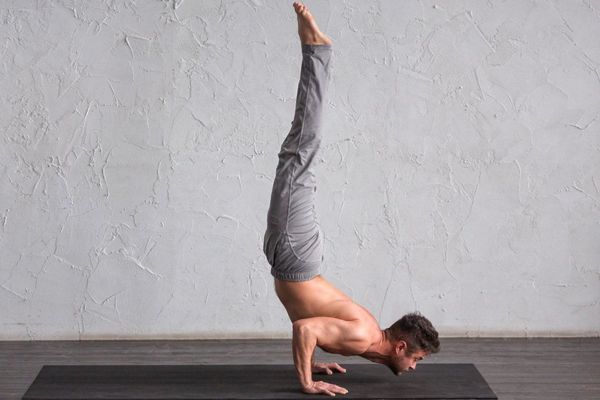
Adho Mukha Vrksasana (Handstand)
Instead of pressing the floor away with force, think of the hands reaching down and the legs reaching up — creating a tensile line of energy through the whole body. The more even the tension, the lighter the pose feels.
Eka Pada Rajakapotasana (King Pigeon)
Rather than forcing flexibility in the hip or spine, create a web of balanced tension — lifting through the chest, grounding through the front shin, extending through the back leg. The curve forms naturally from integration, not isolation.
Bakasana (Crow Pose)
Beginners often rely on arm strength here. Instead, focus on spreading the weight evenly — engage the core, round the upper back slightly, and feel the fascia connecting fingertips to feet. When tension is balanced, the lift happens almost effortlessly.

The Inner Shift: From Doing to Being
Learning yoga through tensegrity is not just a physical refinement — it’s a philosophical one.
Yoga has always taught us to balance opposites: effort and surrender, strength and softness, body and breath. Tensegrity is the scientific reflection of this same wisdom.
When your practice becomes less about doing more and more about feeling balance, you experience yoga as it was meant to be — a moving meditation, a state of dynamic harmony.
Your body becomes supple yet strong, grounded yet weightless.
Your breath becomes the bridge between tension and release.
And your mind learns to trust the intelligence of the body.
Why This Matters for Your Yoga Journey
In today’s fast-paced, performance-driven yoga culture, it’s easy to get caught up chasing difficult postures. But if you truly want to learn yoga — not just imitate it — you must explore the deeper principles that sustain those postures.
When you cultivate tensegrity and structural balance:
- Your joints stay healthier
- Your movements become more efficient
- Your strength feels sustainable
- Your presence deepens
You stop practicing against your body and start practicing with it.
A Call to Evolve Your Practice
The next time you step on your mat, ask yourself:
“Am I using my muscles, or am I using my structure?”
Try exploring each asana as a web of balanced tension. Let every pose become a dance between gravity and grace.
When you begin to learn yoga this way, you’ll notice something profound — you’re no longer chasing poses. The poses begin to emerge naturally, from a place of inner coherence.
Your body becomes a living expression of balance, and your practice — a pathway to effortless strength.

Final Thoughts: Beyond Muscle Lies Mastery
Yoga is not a sport of strength or flexibility. It’s a study of intelligent movement — of how the human body can organize itself in harmony with the forces of life.
To learn yoga beyond the surface is to step into that intelligence — to discover that real power lies not in the biceps or hamstrings, but in the invisible balance between tension and release.
Tensegrity isn’t just an anatomical concept; it’s a metaphor for life itself. Just as our bodies rely on dynamic balance, so do our minds and emotions. When tension and openness coexist in harmony, we find stability not through rigidity, but through flow.
So the next time you hold a pose, remember:
You are not holding yourself up — you are being held by balance.
And that’s where yoga truly begins.